
Fiber laser cutting machines are water-cooled. The chiller keeps the laser source, the optics and the cutting head inside a narrow temperature window, and in most workshops the loop is filled with plain water. That works until the first cold night: water expands when it freezes, and the parts it expands inside — copper pipes, the heat exchanger, pump seals and the laser source’s internal channels — are expensive to replace.
Why a fiber laser chiller needs antifreeze
A fiber laser converts only part of its input power into light; the rest leaves as heat, and the chiller carries it away through two loops — a low-temperature loop for the laser source and optics, and a high-temperature loop for the cutting head and machine body. Water is the best heat-transfer fluid for the job, and the worst one to leave in the machine when the temperature drops.
- Freezing expands. Ice takes about 9% more volume than water. In a closed loop that pressure has nowhere to go, so it splits copper pipes and cracks heat-exchanger plates.
- Pump seals fail first. A frozen pump can shear its seal or crack its housing the moment it is started again.
- Ice plugs overheat the laser source. Even a partial plug reduces flow; the source then runs hot, derates or trips.
- Frost is not only a deep-winter problem. An unheated workshop, a clear night and a machine that is switched off for the weekend are enough for sub-zero temperatures at 4 a.m.
When to switch to an antifreeze mix
The practical rule: as soon as overnight ambient temperature at your site can reach 0 °C, drain the plain water and fill a glycol mix. Do not wait for the first frost — the damage happens in a single night.
If the machine runs in a heated hall you can normally keep plain water, but a power cut or a weekend with the heating off can still freeze the loop. A weak mix costs very little and removes the risk.
In cold weather our service team also sets the chiller a little warmer, so the fluid keeps a margin above freezing:
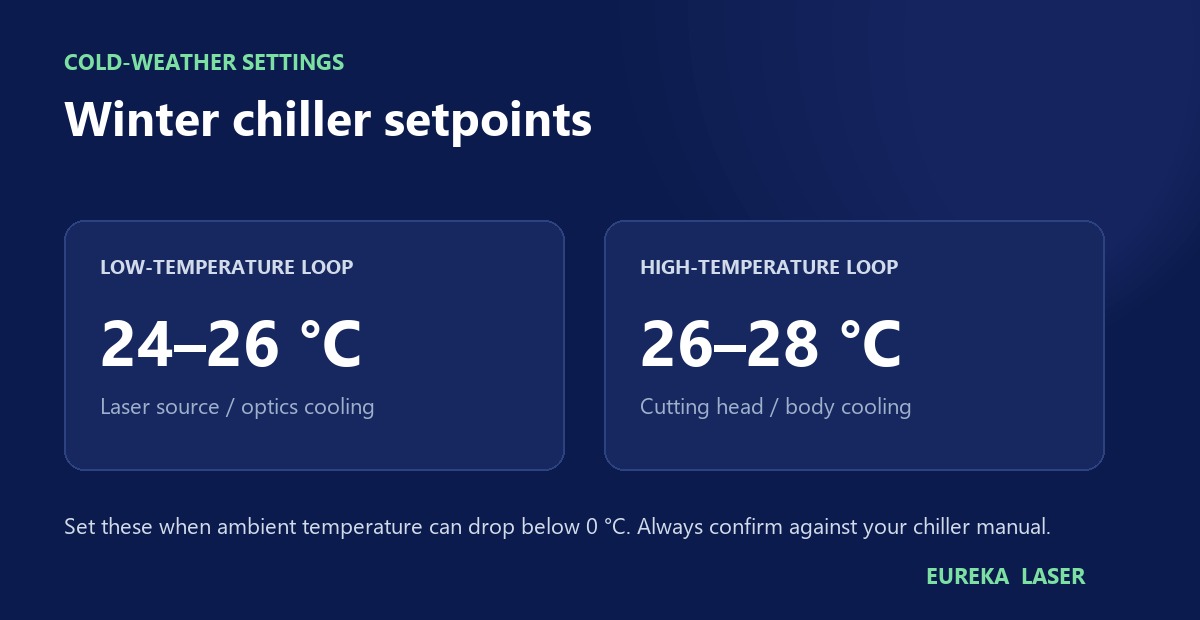
Reference values: low-temperature loop 24–26 °C, high-temperature loop 26–28 °C. On single-loop chillers use the setpoint the manual gives for your laser power.
Antifreeze mixing ratios
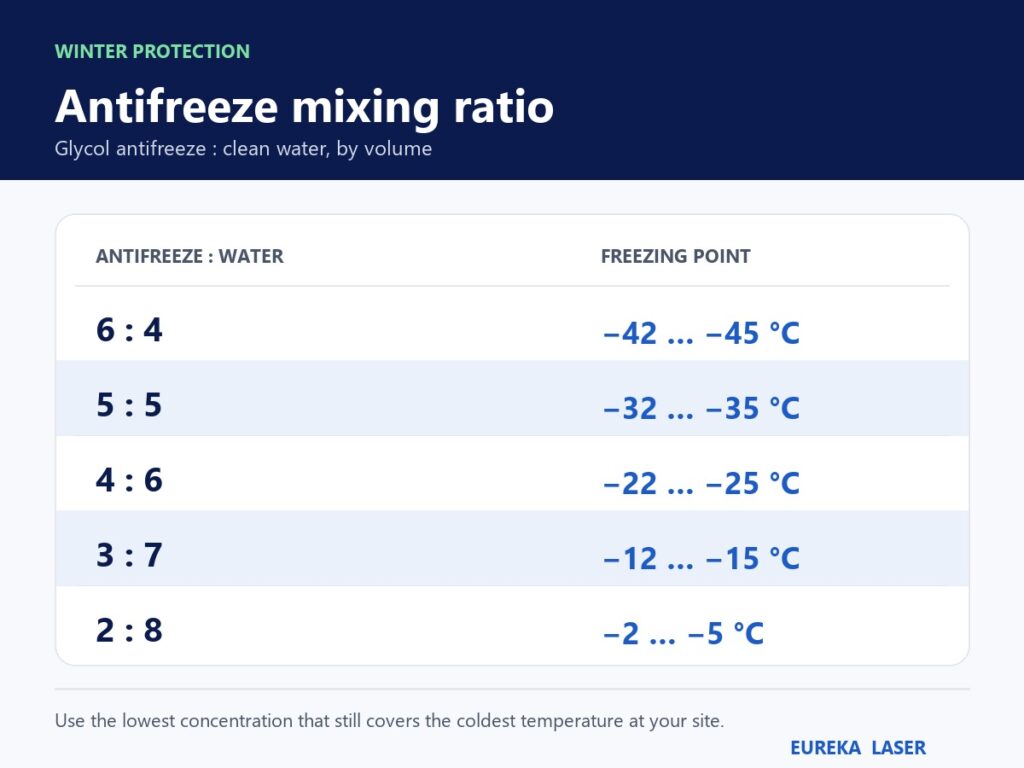
The ratio is always antifreeze : clean water by volume — 5:5 means 5 litres of antifreeze plus 5 litres of water, not a 50% top-up of the tank. The table below gives the freezing point for each mix.
| Antifreeze : water | Freezing point |
|---|---|
| 6 : 4 | −42 … −45 °C |
| 5 : 5 | −32 … −35 °C |
| 4 : 6 | −22 … −25 °C |
| 3 : 7 | −12 … −15 °C |
| 2 : 8 | −2 … −5 °C |
Three rules keep the mix safe:
- Use the lowest concentration that covers your climate. More glycol lowers the freezing point but also reduces heat-transfer efficiency and raises viscosity, so an over-concentrated mix makes the chiller work harder.
- Use chiller-grade glycol with a corrosion inhibitor package. Pure glycol protects against frost but not against corrosion; cheap fluid without inhibitors attacks the aluminium and copper in the loop.
- Mix with clean, low-hardness water. Hard tap water leaves scale on the heat exchanger — use purified, demineralised or soft water.
How to change the coolant: 5 steps
- Isolate and drain. Switch the machine off, then the chiller, and disconnect it from the mains. Put a container under the drain valve, open it and let the loop empty completely. If the loop has a high point, open it so air can enter — otherwise water stays trapped in the pipes.
- Mix in a separate container. Measure antifreeze and water by volume in a clean bucket: for a 5:5 mix, 10 litres of coolant means 5 litres of antifreeze and 5 litres of water. Never pour concentrate straight into the chiller tank — it will not mix properly and the local concentration will be far too high.
- Stir until uniform. Glycol and water separate slowly; stir for a minute or two until colour and density are even.
- Fill and circulate. Pour the mix into the tank up to the marked level, power the chiller on and let it circulate for 5–10 minutes. Air leaves the loop and the level drops — top up with the same mix, not with water.
- Check and log it. Look for leaks at the pump, fittings and the laser head, run the machine and confirm the temperature holds. Write the date, ratio and litres in the maintenance log, and check the level again after the first week.
Common mistakes to avoid
- Pouring concentrate directly into the tank — the mix is never uniform.
- Mixing different types or brands of antifreeze — inhibitor packages can react and form sludge.
- Buying the cheapest fluid — no inhibitor package, and the loop corrodes from the inside.
- Draining only the tank — water left in the pipes dilutes the new mix and can still freeze.
- Topping up with water after the mix — the concentration drops with every top-up.
- Leaving the old fluid in over summer — inhibitors degrade and the fluid turns acidic.
FAQ
Can I use car antifreeze in the laser chiller?
Usually not. Automotive coolants are formulated for engines and often contain silicates or phosphates that are not compatible with the aluminium and copper in a laser chiller loop. Use a chiller-grade glycol with a corrosion inhibitor package, or the product the machine manual names.
What if the workshop never goes below 0 °C?
Plain, soft water is fine while the machine sits in a heated space. If the hall can be unheated at night or over a weekend, a 2:8 mix is cheap insurance against a single cold night.
How often should the coolant be changed?
Once a year, before the cold season, or according to the manual. Change it sooner if it turns cloudy or dark, if its conductivity rises, or after any repair that opened the loop.
Need a hand before the first frost?
Tell us your machine model, laser power and the lowest temperature at your site — our service team will confirm the ratio and the setpoints for your chiller. We can also quote a spare pump, a heat exchanger or a complete coolant change kit.
Contact our service team or browse our fiber laser cutting machines.
